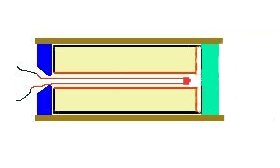
The second grain was LiNO3/KNO3/Sorbitol, 27.5/32.5/40 ratio. This grain weighed 12.2 grams
The third grain was LiNO3/Sorbitol, 55/45 formula. Grain weighed 11.2 grams
It was noted that even short exposure to air allowed visible amounts of moisture to form on the LiNO3 crystals. It was very difficult to work fast enough to avoid this.
The three grains were stored for weeks in double baggies with CaCl2 dessicant. When I went to do the static testing the KNO3/Sorbitol grain looked fine and tested the same as earlier single grain motors of this type
The grains containing any LiNO3 had gained significant moisture on storage. Core goop was reamed out and static testing attempted. A soft ruddy flame was noticed on the LiNO3/KNO3/Sorb motor. However the motor did not come up to pressure and took 9 seconds to burn with no thrust.
The third grain was similar except very difficult to light.
At this point it appeared that the moisture and/or the low motor KN-avg ~60 were the possible problems.
To address the motor KN question a two grain motor was made keeping the nozzle diameter the same, KN-avg ~120. These two grains had been stored in an air tight container but moisture during casting had caused them to be soft enough to slump. They were place in a casing and tested the same evening at a VAROOM pour night.
By the time we went to test this motor it had accumulated a lot of moisture. The ignitor hit goo so it was pulled out and the core reamed out with a dowel.
Several ignitors failed. This was a night test and when the motor finally ignited it burned with NO flame and NO thrust and little sound causing Brett to exclaim, "It's a stealth motor !" :-)
So an increased motor KN did not solve the problem. Moisture is probably the culprit so a LiNO3/KNO3/So 27.5/32.5/40 grain was made by mixing a 20 gram batch in a sealed container with ball milling.
This was melted as fast a safely possible in the open air and poured. The grain was allowed to cool and cure in a sealed dry container. Grain was stored in this same container.
After storage this is the first Lithium grain that looked dry. So I installed it in a casing and sealed the end with 5 minute epoxy and static tested as soon as possible.
This was a single grain so I used a smaller nozzle to get the average motor KN at about 100.
FINALLY SOME THRUST ! the motor burned at a lower thrust for a longer time period as compared to standard propellant. A problem came up though; since I had such trouble igniting the earlier grains I primed the core and ends of this grain with a lot of meal powder slurry. This caused a POP on ignition which set the spring thrust scale into oscillations.
Smoothing out the oscillations and plugging the curve data into EngEdit gave some preliminary rough data on the performance of this hybrid oxidizer formula.
SEE TABLE BELOW:
|
Formula
|
Grain volume mm3
|
Grain mass
|
Avg Thrust Newtons
|
Total Impulse NS
|
Peak Thrust N
|
Burn Time seconds
|
Flame color
|
|
KN/So
|
6503
|
13.1
|
9.6
|
7.9
|
16
|
0.83
|
none
|
|
LiN/KN/So
|
6503
|
13.0
|
3.1
|
5.9
|
4.4
|
1.9
|
none
|