Goal of this experiment is to see how the SRM.xls "ends" workaround used with the "two" grain motor
will work for a three grain motor. This motor eliminates the variable of the different grain lengths and focuses on the "ends workaround."
However this motor contains an "extra end" at ignition as the full surface of the delay grain will burn one Tweb deep during thrust.
After the thrust portion of the burn the remaining delay grain burns at ~1 atm giving a 5 second delay.
Using a full length cap for the delay grain gives a 13 second delay.
The standard use of SRM.xls has the multiple grains (N) the same size/length as each other.
It also has all the grain ends inhibited (Ends=0) or all ends not inhibited (Ends=1).
However some of the multigrain motors have grains that differ in length. In the three cored grains one end is inhibited and the other not.
It is hoped that the sim results of the SRM.xls thrust curve vs time can be made to
correlate with static test thrust curve vs time results. This would preferably be by adjusting input rather
than the more complicated approach of changing the internal calculations within SRM.xls
The motor was constructed as per the image above. The red areas shows the non-inhibited
surfaces along with the ignitor. The motor was then ignited on a static test stand to measure thrust.
This is a spring weight scale. The static burn is videotaped and the thrust over time is plotted by analyzing
each frame for thrust. The video captures 30 frames per second.
The sim results are obtained by entering the chamber and grain data into the Excel file and solving for output.
Once these graphs are available they are roughly compared for maximum thrust, burn time, and if the thrust curve is
neutral, progressive, or regressive.
Any obvious differences in the sim file are addressed by changing input into the SRM.xls file.
Of course the input changes need to reflect reality so the focus is changes that reflect the non-standard
construction of these grains.
Each graph below shows the static results from motor #74s (diagram at top of page) in red against the sim results (in black).
In each succesive graph the sim is changed by changing the "ends" input (ends = 1, 0, and 0.5)
The graph above has the sim with ends=1 so SRM calculates all ends burning. This gives an expected fairly neutral burn.
The static is progressive. Not surprising since one end per grain is inhibited. (See motor image above, red areas represent unhibited surfaces at ignition.
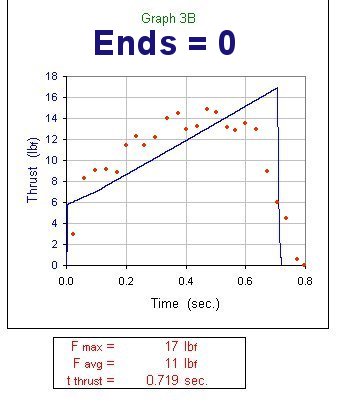
Above is the sim with ends=0 meaning that both ends are calculated as inhibited.
Like the "two" (1.5) grain motor (my standard D16 motor) the second half of the static burn is not as progressive as the sim.
Again this makes sense since the static motors have one end per grain exposed.
So once again to compensate in the sim input we enter ends=0.5 This will calculate that one end burns and the other is inhibited.
Now.. does the adjusted sim reflect reality?
See graph image below:
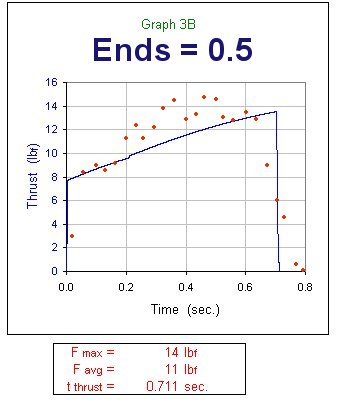
The last two sim graphs do the best at predicting the actual static.
The ends=0.5 approach would probably be closer if the delay grain was eliminated. It is not accounted for in the Sim set up.
Yet it is providing a full end surface area from the start of the burn. Accounting for this extra end burning grain is beyond the scope of this project.
Another dimension not accounted for in the sim is the cores in the motor were actually staggered. The grain nearest the nozzle had a wider core than the two other grains.
I might try fine tuning these factors in the future (NOT :-) The current sim accuracy is sufficient for my needs.
The static data entered into EngEdit gives a designation for this motor as an E43. (total impulse is 35.2 NS)
The simmed data (with ends=0.5) gives this motor a designation of an E48 (total impulse is 34.3 NS)
Note to myself to try later:
Using a longer delay grain with a partial core (similar to the 1.5 grain motor) would make this a three and a half grain motor.
That sims as an F58 (total impulse: 41 NS)